Because I have been involved in video production since 1982, I wanted to distill nearly 30 years of what I have learned about the process into five important things that you need to know if you ever want to make or share video that is to be taken seriously by your potential viewers. Many people now have the capacity to shoot and edit video at a fraction of what it used to cost in the “old days.” Also, viewers are voracious for video. But if you want your video to stand out in the crowd, you need to follow a few rules of proper videography. You don’t want to be the guy who produces the video that becomes the example of what not to do!
1. Use a tripod, use a tripod, use a tripod. Yes, “The Blair Witch Project” was very popular when it first sprang into being, but running-with-a-camera-through-the-woods is not a technique that you want to abuse. Certainly you can vary the footage you shoot with a tripod, with hand-held shots, Dutch angles and POV (point of view) shots, etc., but balance is key. The dead give-away of a non-professional video is the lack of a TRIPOD. When shooting, do not swing your camera back and forth in a dizzying manner. If you want to pan left to right, or tilt up and down, do it slowly and evenly. You can always speed the shot up in post production if you need to. (Note: fast pans and tilts don’t translate well on the web.) The DPs (Director of Photography) on certain shows may pan and tilt erratically, but my feeling is that you have to know and understand the rules first before you can break them. There is a reason these high-end DPs are paid well.
2. Content is King. If you happen to catch something amazing with your cell phone, like a meteor striking the post office, or a church steeple hit by a tornado, then that clip has the potential to circulate rapidly around the world. But prior to just posting the clips immediately, or giving them away to the local news station, you may want to call up a reputable stock-footage library and see if they would like to rep your footage. Timing is essential, so don’t wait too long. Typically the stock footage house takes 50% of proceeds, and you get 50%. If you don’t ask, you don’t receive. If you have captured amazing clips on a higher-end video camera, all the better.
If there is a potential to sell your clip, why give it away? For instance, on a local mountain biking website a few years ago we saw the clip of a guy falling off his mountain bike down a steep gorge in the high desert. Since we have a stock footage library (New & Unique Videos) which constantly receives requests for wacky, offbeat, crazy, and/or extreme footage, we offered the site owner a 50/50 percentage of any money we could make by selling his clip. For some unfathomable reason, he declined. The guy was sitting on a potential gold mine and yet he couldn’t be bothered. In this current economy, we all have to be that much more creative about bringing money in. And remember, America’s Funniest Home Videos is not the only lemonade stand on the block.
3. Obtain great interviews by respecting the pause. Prior to shooting footage of your interview subject, google their name and find out all you can about them. You should have all your equipment set up and ready to go so they don’t have to wait around and waste their valuable time. Make sure you set them at ease by conversing as with a friend.
When the camera op (perhaps that will be you) “pulls the trigger,” ask all the Who, What, When, Where and Why questions you can think of that you want them to answer. However, and this is very important, you must sense when they have completed their thought. If they haven’t, and you happen to interrupt them, you could be shooting yourself in the foot. They might have been about to reveal something poignant, personal, amusing or amazing, but you were too busy talking without really listening. Respect the pause. Also, do not position them against a wall or backdrop like those annoying late-night commercials with the lawyer standing right in front of a bookcase. Make sure there is at least a six-foot distance between the subject and the background. Ten feet’s even better. You want some depth of field with the background slightly blurred.
4. While editing, use special effects sparingly. I remember the first piece I ever edited. I had to use every single wipe, flip, flop and effect. Sure sign of an amateur. You want your piece to flow without any weirdness. You want it to be virtually seamless. Yes, titles and captions need to look cutting-edge but not every transition has to be a clock wipe or a white flash. You can use those when the footage calls for it. Let the footage tell the story and don’t distract the viewer with unnecessary effects. KISS (Keep It Simple, Stupid.)
5. Perhaps this should have been number one on the list, but I am leaving it for last, so that it makes a lasting impression. Prior to shooting your video, you need to decide if it’s worth devoting the kind of time that it will require. If you don’t feel passionate about it, or if a client is not paying you well to do it, and if you don’t see yourself staying up late into the night editing it, or don’t feel it’s going to change your life, then don’t do it. Just wait until you get an idea in mind that you don’t mind “marrying” until it’s not only “in the can,” but “in t
he box” and “in the hands” of friends and loved ones. Believe me, it’s going to take up a lot more of your time than you think it will.
Of course there are many more things to learn about the ins and outs of video production, such as sound, shooting outdoors, shooting in studio, working with celebrities, etc., but with these five tips in mind, you can at least get started, and perhaps become the next Sam Raimi. Or the next you!
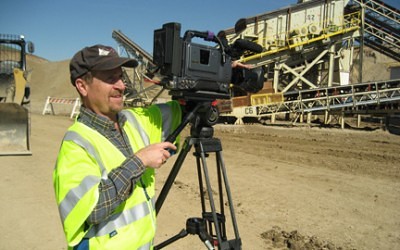
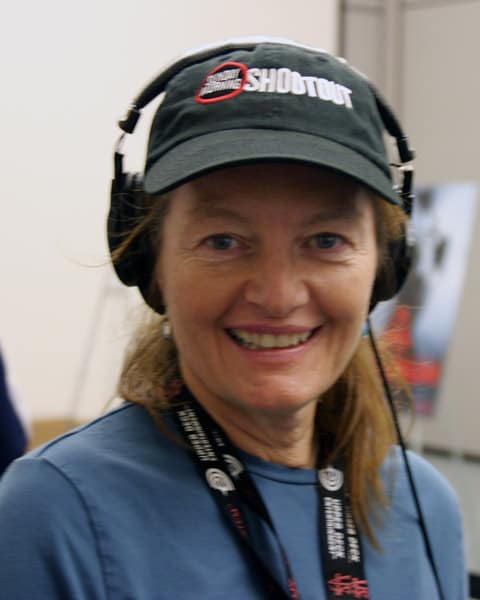
Photos by Patty Mooney
Top photo: Mark Schulze captures 50th Anniversary of Blue Angels, El Centro, California
Second photo: Mark Schulze prepares to interview Deepak Chopra
Bottom photo: Mark Schulze poses with Robby the Robot from “Forbidden Planet”